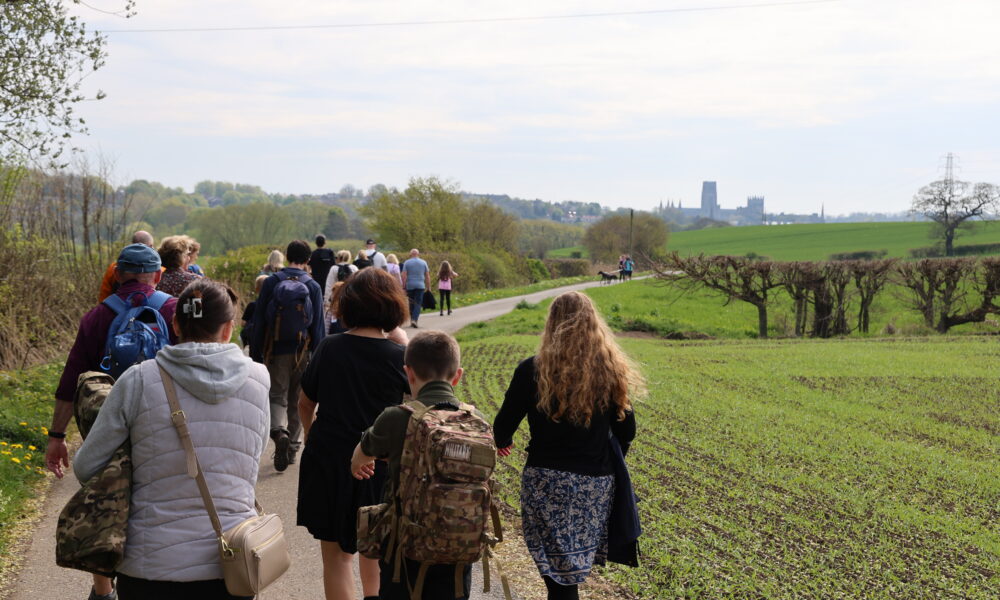
The resurgence of interest in pilgrimage is something every church can nurture
The Revd Professor Dee Dyas OBE, storytelling and heritage for missionMission 1. A group of people sent out to share religious faith. 2. The task of sharing faith. lead for FaithFaith 1. Belief and trust in someone or something. 2. Acceptance of particular religious teachings. in the North, writes in today’s Church Times about the resurgence of interest in pilgrimage. The article follows in full
In case you hadn’t noticed, pilgrimage is in the air. All over Britain, old pilgrimPilgrim 1. In the New Testament and Christian thought, someone engaged in the Christian journey through life towards heaven. 2. Someone who journeys to holy places (such as biblical sites or shrines of the saints) to seek God's help, to give thanks, or as an act of penance routes are being revived and new ones established; celebrity pilgrims appear regularly on our TV screens; bishops (and archbishops) often begin new phases of ministry by undertaking a pilgrimage; and growing numbers of people of all ages and backgrounds appear to want to discover what pilgrimage can mean for them.
Earlier this year, The Spectator announced: “Britain is experiencing a pilgrimage revival.” Many, whether from a ChristianChristian Name originally given to disciples of Jesus by outsiders and gradually adopted by the Early Church to designate all members of the church. background or not, are choosing churches and other Christian sites as their goals or as pause points along the way. So, what significance does this have for churches and mission today?
It is easy to take it for granted but this level of interest is very recent. Pilgrimage flourished in this country in the Middle Ages, leaving a rich heritage in many cathedrals and other churches, but was very firmly suppressed at the Reformation. It was seen as unnecessary (since God was everywhere), and many people had ceased to trust the somewhat dubious saints’ relics and experiences on offer. Shrines were dismantled, and for centuries pilgrimage languished.
There was a gradual revival of interest in pilgrimage to the Holy LandHoly Land A common term for the area of what is now Israel/Palestine where Jesus spent his earthly life. Such a term expresses the allure of pilgrimage to the actual places where Jesus lived and died and was also a concept which inspired the crusading movement. and a few other sites in the 19th century. Some attempts were made to reinstate organised church pilgrimages from the 1930s onwards, but these were small-scale developments. For much of the 20th century, the term “pilgrim” was simply church speak for an acceptably well-behaved visitor.
The widespread resurgence of interest in pilgrimage only began in the 1980s, although it has grown exponentially since. The increase in pilgrimage to Santiago de Compostela, which is one of the main drivers of the current revival of interest, illustrates this clearly. In 1980, just 209 pilgrims were recorded, whereas in 2025, the number was more than 530,000.
This spectacular growth is mirrored elsewhere. ReligiousReligious 1. Concerned with religion, showing belief in God or a deity. 2. In regards to an individual, refers to a member of an order of monks, nuns or friars who follow a Rule of life pilgrimage involves more than 300 million people from different faiths worldwide each year. What is sometimes called “secularSecular (from Latin seculum 'world') 1. In the world (i.e. not monastic). 2. In modern use not religious or spiritual.” pilgrimage accounts for many millions more, as people journey for well-being, time out, processing aspects of their lives, or for the sheer joy of walking, cycling, and engaging with landscapes and places along the way. So why is this happening now? What does it tell us about human nature and human needs? What does it mean for churches in terms of new mission opportunities, pastoral care, community engagement, and sustainability?
As someone who has spent three decades researching the history and meaning of pilgrimage and helping churches of all sizes develop resources to share the Good News of JesusJesus (Greek form of Hebrew 'Joshua' meaning 'Yahweh [God] is salvation') Also given the title Christ, meaning 'anointed one' or Messiah. His life is recorded mainly in the Four Gospels although he is also mentioned by the Jewish historian Josephus (c. 37-c.100) and the Roman historian Tacitus (c.110). Christ, I believe that pilgrimage is truly a gift to the Church for our times. We are seeing Christian spiritualitySpirituality Term used to describe the experiential dimensions of religion, encompassing aspects such as prayer, meditation, contemplation, and mysticism., contemporary interest, and need converging in an extraordinary way. This offers creative openings for all of us, from whatever church tradition, to reach out and serve the world around us.
Pilgrimage is one of the richest themes in Christian spirituality, and offers multiple pathways to exploring a relationship with God. These include viewing the whole of life as a pilgrim-journey with God at our side; using prayer as an inner spiritual pilgrimage bringing us closer to God; and resourcing our life journeys through visiting special places to learn more about God and find forgiveness, healing, guidance, comfort, and hope.
These pathways emerge from both the Old and New Testaments and from the experience of believers through the centuries who have wanted to know God more deeply. These different ways of being a pilgrim can all work together. We can find encouragement and perspective for daily discipleship, resources for pastoral care, and creative ways to share faith with others.
It is common to speak of the whole of life as a journey. Seeing life as a journey with God, encountering joys and setbacks, roadblocks and breakthroughs, offers a helpful perspective. And many of us recognise we are on an ongoing inner emotional or spiritual journey. The different ways of “being a pilgrim” in Christianity therefore offer a unique opportunity to communicate and connect with people today, inside and outside congregations, enriching both discipleship and mission.
Many people outside churches find the idea of being a pilgrim very appealing because pilgrimage is almost the only Christian term that doesn’t need explanation. There is a widespread intuitive understanding that a pilgrimage is “a special journey to a special place with a special meaning”. This can be to a religious site, a football ground, or an important place from our past.
By examining what is happening around us, we can develop the many creative initiatives already underway. This means bringing together the general background factors — why are human beings through the centuries seemingly “hardwired” to respond to journeying and engaging with special places? — and the current points of connection: why are these deep-rooted responses of special relevance to the interests and needs of so many people today?
The purpose of pilgrimage in previous centuries was to take time out from everyday life and to discover new experiences, answers to problems, and the potential for personal growth. Growing in faith and seeking God’s graceGrace 1. The undeserved favour of God, given to enable an individual to grow spiritually.2. A prayer of thanksgiving said before meals. was at the heart of many journeys, but there was also often an element of adventure and exploring the world. The distance travelled was not necessarily the defining factor. For example, the redoubtable medieval pilgrim Margery Kempe travelled to Santiago de Compostela, RomeRome This Italian city was the capital of the Roman Empire and, with the primacy accorded to the bishops of Rome (the popes), the centre of the Western Church from the late-Antique period onwards. Rome was not only the administrative centre, but an important source of innovation, relics and liturgy. Missionaries from Rome played an important role in the conversion of Anglo-Saxon England from late 6th century onward., JerusalemJerusalem City captured and made into the capital city of Israel by King David. Site of the Temple built by Solomon, and of the Crucifixion and Resurrection of Jesus. A holy city for Jews, Christians and Muslims, and Assisi but also went “on pilgrimage” to a church two miles from her home.
Pilgrimage in the past was about visiting sites which helped people explore meaning and find new resources for daily life. It appears that human beings have always been programmed to find meaning in or map meaning onto places. Places associated with key events are marked and remembered because they are part of the road map of our lives. That is why mini “shrines” pop up whenever there is a tragedy. People today are once again looking for places to add meaning to their journey through life, help them reflect on that journey, and find guidance and support.
A very significant driver in the resurgence of pilgrimage today is simply the scale of human need and the desire to find ways to navigate a very challenging world. William and Lavina Lim, the creators of a secular art exhibition staged in Hong Kong in 2023, wrote: “The journey through life is filled with wonder, challenges, broken hearts, extreme highs and lows, celebrations, special moments, and memories that define our experience as a human. It is these events, planned or unexpected, that impact our travels and define our purpose.”
In 2020, we found out what it was like to be hit by a pandemic we couldn’t control, which changed all our lives, caused huge disruption and lasting loss — and left so many grieving and alone. We live in a world of seemingly endless conflict and suffering, where the decisions of the powerful, thousands of miles away, can cost the lives of so many. We have vastly more technology, medical care, and wealth than our medieval forbears. Yet we too have finite lives, we too have hostages to fortune in the ones we love, we too cannot predict the future.
Tens of millions of people come into church buildings each year, intrigued by their peace, history, art or architecture, or drawn by the huge number of activities provided. Extensive research tells us that many are then prompted to think about their own lives, but that a high proportion don’t have the background or vocabulary to explore the meaning of what they see and feel. Words like GospelGospel (Greek evangelion, Old English godspel 'good news') 1. The central message of the Christian faith concerning salvation. 2. Title given to the four New Testament books which describe the life of Christ i.e. Matthew, Mark, Luke and John. 3. A reading taken from one of the four Gospels which has the place of honour in the Eucharist, crossCross Instrument of torture and execution used in the Roman Empire. The means by which Christ was put to death and therefore the primary symbol of the Christian faith, representing the means by which he is believed to have won forgiveness for humankind. The Cross may be represented as Tau-shaped (like a capital T); with a shorter cross-bar or with a circle enclosing the upper intersection (Celtic). In medieval art a cross made of living branches signifies the Tree of Life. St Helena, mother of the Emperor Constantine, is said to have discovered the True Cross (i.e. the Cross in Jerusalem on which Christ died) in 326., ResurrectionResurrection That Jesus rose from the dead, thus conquering death, and that everyone will rise from the dead for the Last Judgement is a central Christian belief., and naveNave The central aisle in a longitudinal (basilican) church, often used for processions. Also the area used by the congregation during worship. do not exactly trip off the tongue for most people. Some do not even know who Jesus is.
Church buildings can seem intimidating to newcomers, and hard to navigate and understand. However, if we ask local communities, visitors, and schools: “Would you like to try being a pilgrim?” and provide resources, we know that this does communicate and is very appealing.
There is an obvious question as we seek to engage with pilgrimage today: who or what is a pilgrim? Is it only the person with rucksack and walking boots who has travelled far through sun, rain, and mud? Is it only someone whose pilgrim journey is planned and purposeful? Or is there room for people who — to their own surprise — find themselves responding spiritually, quite spontaneously, when in a special place?
I suggest that we should view “being a pilgrim” as a state of openness to spiritual exploration through place and journey, whether planned or spontaneous. This includes those who travel with a clear intention and those who may find themselves unexpectedly affected by the beauty, atmosphere, worshipWorship 1. Doing homage and giving honour and respect to God. The Bible includes a wide range of physical expression in worship, including bowing down, lifting hands, dancing, processions and singing. The main day on which Christians gather for communal worship is Sunday (the day when Christ is believed to have risen from the dead). 2. Christian liturgy including sung material and prayers of thanksgiving and praise., and stories that churches offer. If a pilgrim is a spiritually responsive person on a journey through life, then everyone is a potential pilgrim.
I was once asked to review an audio-guide for a very famous church. It began: “We welcome you whether you come as a tourist or a pilgrim,” immediately setting up an opposition between these categories. I have worked with many cathedrals and parishParish Area with its own church, served by a priest who has the spiritual care of all those living within it. The system evolved gradually, reaching completion by the 13th century churches on visitor engagement and mission and there is frequently a danger that we mentally “triage” people into separate categories: visitor or tourist, school child, worshipper, pilgrim. However, research shows very clearly that many people experience a wide range of reactions during a single visit.
We often hear of census results which show people ticking the “no religion” box on the form. Interviewing these “nones” (as the sociologists call them) reveals that this simply indicates that they aren’t part of any formal belief system. Many are interested in spirituality and keen to go on pilgrimage, light candles, and leave prayers. This is something churches really need to grasp and engage with.
Someone initially attracted by heritage, beauty, or peace may find themselves responding in unanticipated ways: perhaps seeking comfort, needing to explore unexpected emotions, or taking the chance to think about their lives. We cannot see what is happening beneath the surface, what burdens or questions people are carrying, but we can offer the opportunity and resources to stop and think about their lives.
A four-year research project with the Church of England, observing and interviewing those engaging with cathedrals today, provided fascinating and very encouraging insights. People who self-identified as visitors or tourists (rather than as worshippers or pilgrims) commented: “I spoke to someone about the meaning of life” and “I meditated and lit a candle.”
One self-described non-believer responded: “My impression of this place was — wow! This cathedralCathedral (Latin cathedra' throne') Church which contains the throne of the bishop and hence the mother church of the diocese is not only rooted in the earth but rooted in time” and commented that the cathedral was “a witness”. His conclusion? “I think I am becoming a pilgrim.” Another said that by attending EvensongEvensong The medieval English name for the office of Vespers (see Divine Office). Used in the 1549 Book of Common Prayer for the service which later prayer books call Evening Prayer and listening to the sung psalms, they “felt bathed and cleansed by those sounds. Sound-washed.”
A guide at DurhamDurham Durham Cathedral has its origins in the small church built in 995 to protect the relics of St Cuthbert. A century later, construction began on the church of the Benedictine Abbey, and Cuthbert's remains were transferred there and placed in a shrine in 1104. In 1242 the bones of Cuthbert were once again moved, this time to a shrine near the entrance of the Chapel of the Nine Altars. Cathedral told of a man with tears in his eyes saying: “What’s this place doing to me? I am a secular person!” That research showed such a widespread desire to try prayer that “Explore” prayer cards were developed to offer everyone a chance to start talking to God, together with further options for exploring faith. That the need was real is evidenced by the fact that more than three million prayer cards have gone out so far, with a “Being a pilgrim” set recently added for those who find this a useful way into spiritual exploration.
Whatever our churchmanship or theological stance, we need to recognise the power of church buildings and worship to touch and transform lives. This is not to say that churches or other Christian sites are inherently more holyHoly Set apart, sacred, especially implying coming from or consecrated to God. than other places or that God is somehow more “present” or accessible there. God is everywhere through his Spirit. We are never out of his presence. He is always alongside us on our daily journey through life. However, ever since the TabernacleTabernacle 1. The portable tent, or sanctuary, in which God was worshipped in the wilderness during the Exodus from Egypt.2. Jewish Feast.3. Niche or recess for images. and the Temple, places of worship have had a special role in pointing us to God’s greatness and goodness. Now they proclaim his desire for us to know him in Jesus Christ.
Church buildings are multi-layered storybooks holding the stories of the congregation and local community, and the greater ongoing story of Christianity which invites everyone to experience it for themselves. Churches use human creativity to help us step back from our daily busyness and pay attention to God, just as walking through a stunning landscape can make us stand still in wonder and praise. This is their job and we need to help them to do it well.
In doing so, it is vital to take on board what neuroscientists and others now report about the way human beings respond to our environments. I have spent decades exploring the impact of Christian churches, art, literature, music, and worship on a wide range of audiences, asking why human beings are affected by places and ritual, and how this could help us connect and communicate today.
It is illuminating to see how descriptions of encounters with God in the Bible and succeeding centuries can be understood in greater depth through insights now being produced by neuroscientists and others. These are not just scientific conclusions — they are highly relevant insights into the way humans have been created by God and designed to respond to him.
One undisputed fact is that all human beings can only learn and respond through our senses, which are thought to be more than 30 in number. Crucially for thinking about churches, these include kinaesthesia (the sensation of movement) and proprioception (the perception of the position of the body in space), flagging up the importance of movement and action when it comes to interactions with buildings.
Moving through spaces, kneeling, touching, experiencing the chance to light candles, write prayers, or carry out simple acts such as placing pebbles or petals in a bowl, all help to forge deep connections. Human beings need rituals to frame our lives. If we don’t inherit them, we invent them — although, as in the case of pop-up shrines, with candles, prayers, and gifts, they often look remarkably like what has gone before.
Places create and hold memories, and emotion plays a big part in this. Researchers are now demonstrating that emotions are not superficial “feelings” to which one person may be more prone than another. Instead, scientists are clear that emotions are not an optional extra but integral to reasoning and decision-making. Without them, people cannot develop preferences, interests, motivation, morality, creativity, or the capacity to build memories.
Awe is a particularly strong emotion which can act as a reset button, causing us to emerge with new selves and values. Neuroscientists also point out that our brains are capable of being fundamentally modified by experience, “rewired” in response to learning, interactions, and environments. This simply sheds new light on what we already knew — that spiritual encounter can truly bring change.
Pilgrimage may be alive and well at present, but history tells us its popularity can wax and wane, according to whether it is seen to meet people’s needs. So how can we grasp this huge opportunity and secure its longevity? How can the riches of Christian spirituality in this area be kept in clear focus, as pilgrimage multiplies and diversifies around us, with all kinds of multi-faith and even paganPagan Derived from Latin paganus, the Roman term for a rural dweller, this word came to be applied to those who were not Christian, particularly the followers of the classical religion of Greece and Rome and those who followed the pre-Christian religions of Europe options on offer? Is it time to develop a national resource hub to support churches in seizing this gift for our time?
Every church leader knows that connecting with people who don’t normally attend church can be very challenging, but millions are delivering themselves to church doors every year, voluntarily putting themselves in the way of the story which has the power to change their lives. We have the chance to reach out and offer the comfort, hope, and new life in Christ which so many need, making their pilgrim encounters with our churches something which can enrich and transform them as they travel on.
How to make your church a Pilgrim Place
A recent initiative from Faith in the North offers resources to help any church, in any setting, become a Pilgrim Place — providing beautiful, peaceful, meaningful, comforting, safe spaces full of stories, in which people can take breath, reflect, and find forgiveness, healing, and strength.
New approaches to mission are being discovered. Hatfield St Lawrence church near Doncaster offered this feedback: “Being a Pilgrim Place is helping us to communicate that church is open not just for services, but for anyone who wants to wander in, breathe, and discover God afresh. We are growing in confidence to welcome visitors, and being a Pilgrim Place is renewing our sense of mission.”
Your church may be on an existing pilgrimage route or walking trail which offers potential for a ministry of welcome and outreach; you may want to develop local trails; or just be looking for fresh ways to welcome visitors and engage your local community, whatever your context.
It is not only in rural areas but in towns, cities, and on large estates, that opportunities to find enhanced spiritual, mental, and emotional well-being are needed. Those who come to foodbanks, toddler groups, exercise classes, or social clubs can also be helped by peaceful spaces, with flowers, perhaps quiet music, candles to light, or prayer cards which tell them that God cares about them and their needs.
However, when we are very familiar with buildings, it can be hard to see them as newcomers do, so it is worth checking our communication. Does the external signage clearly say, “You are welcome to come in”? Is the entrance plainly marked? Does internal signage invite and encourage engagement? There is a world of difference between a notice stating, “This chapel is reserved for private prayer” and one saying, “You are welcome to use this chapel to enjoy a time of peace and quiet prayer.”
Are resources such as prayer cards and trail leaflets available, with signs encouraging everyone to use them and take them away? Such “takeaways” are vital in enabling people to go on exploring faith after they leave, through a supporting website or joining a church. If there are welcomers, are they encouraged to remember that every day, by a smile or a helpful word, they could literally change someone’s life?
Published with kind permission of the Church Times